Archive | Paninindigan

Fight the Aquino regime’s Cybercrime Law! Defend our rights! Uphold free speech on the internet!

Posted on 01 October 2012 by admin

Press Statement

October 2, 2012

Reference: Renato M. Reyes, Jr. BAYAN secretary general

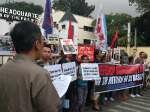
Today we join netizens and citizens in a Day of Action against the draconian Cybercrime Prevention Law. With its vague and overbreadth provisions that attack our constitutional rights and freedoms, it now becomes the duty of Filipinos to resolutely oppose this measure. While those who passed the law in Congress share responsibility for this repressive measure, the buck ultimately  stops with President Aquino, who signed the law last September 12.

Numerous provisions of this law infringes unconstitutionally and constitutes a sweeping intrusion into the people’s freedom of speech, of expression, and of the press, right against unreasonable searches and seizures, and right to privacy, and other fundamental freedoms.

Our opposition to the Cybercrime Law rests on the following:

  1. The law violates our right to privacy. The law allows the government to monitor and record real-time traffic data even without a court warrant and on the mere basis of “due cause”. We find no comfort in the provision of the law that states that only the origin, destination, size and not content and identity will be monitored and recorded without warrant. What is to prevent the authorities from actually prying into content and identity of traffic data when the opportunity presents itself? Furthermore, a law enforcement officer engaged in such collection or recording of traffic data can obtain information, in real-time, as to where anyone used a mobile phone or email, the destination of the call or text or message, the route, time, date, size, and duration thereof, or the type of underlying service that the user avails of. This is Big Brother watching our activities on the internet.
  2. The law increases the penalty for libel and other crimes when committed via the internet. The law is vague on how libel is actually committed over the internet. The law even allows a person to be charged with libel twice (one for internet and one for regular publication), based on the same article. One can even be charged with libel in any province of the country if the alleged libellous article was viewed there by the so-called offended party.
  3. The means of how a supposed crime is committed covers a whole range of devices. The supposed new offense of cybercrime of libel is  supposedly committed by means of “computer systems” which under this law includes cellphones and storage devices as well as “any other similar means which may be devised in the future”.  By not considering the complex, intricate and public interactive nature of cyberspace, the means employed by this provision makes ordinary conversations over mobile phones or the use of interactive functions of the internet (shares, comments, retweets) a target of imposition of the State’s immense powers.
  4. With the creation of a new offense called “cybercrime through data interference”, the law can be used to assault free speech.  The so-called unauthorized alteration of electronic photos used in internet memes  or posters–which is now a common way of expressing political criticism–  can be penalized under this law. In the complex and infinite universe of cyberspace,  the law does not state whether “authority” is based on “ownership” of a computer data (e.g. a person’s ownership over online photos or articles) or by  “mere interest” therein (e.g. a person’s interest over an online photo or article as that person is the one depicted on the said photo or article).
  5. The law violates our right to free speech and due process by allowing the DOJ to take down websites even without a court order. The DOJ becomes “The Great Firewall” as it is able to restrict access to or takedown websites on the mere determination by the DOJ that the website is prima facie in violation of the cybercrime law.
  6. The law violates due process when it penalizes one’s “failure to comply” with orders from law enforcement authorities, even if the non-compliance is valid. This non-compliance is penalized with imprisonment or a fine of P100,000, or both, for every act of non-compliance.

We shall take the fight online, on the streets, in the courts and in Congress. As the law takes effect on October 3, we call for continued public vigilance and sustained actions as our best defense against this blatant assault on our rights. In a time when our freedoms are threatened, we should all the more aggressively exercise those freedoms. Our people’s fight for freedom online is part of a larger struggle against all forms of  state-sponsored political repression that targets dissent and supports the preservation of the corrupt status quo.  ###

DOWNLOAD BAYAN ET AL SUPREME COURT PETITION HERE

Comments (1)

RISE AND FALL OF MARCOS FASCIST DICTATORSHIP: CAUSES AND CONSEQUENCES UP TO THE PRESENT

Posted on 11 September 2012 by admin

By Prof. Jose Maria Sison
Founding Chairman, Communist Party of the Philippines
Chief Political Consultant, NDFP Negotiating Panel
September 11, 2012

(NOTE: This article originally appeared at www.josemariasison.org. We are reposting it as part of the commemoration of the 40th anniversary of the declaration of Martial Law by the US-Marcos dictatorship).

September 21, the formal date of the proclamation of martial law forty years ago, reminds us of the Marcos fascist dictatorship that the Filipino nation had to suffer for 14 long years until 1986. In our forthcoming commemoration, we honor the people and all the martyrs and heroes for their resolute and courageous struggle against the dictatorship. We reflect on the rise and fall of this dictatorship and on the causes and consequences up to the present, in order to know what we as a nation have achieved and how much more we need to do in order to complete the people´s struggle for national freedom and democracy.

It is highly important to undertake such reflection because the political heirs of Marcos and even quite a number of those who benefited politically from the assassination of Ninoy Aquino want to obfuscate the real and most important causes of the Marcos fascist dictatorship and shift the blame for the rise of the dictatorship to the revolutionary movement of the people. It is in the self-serving nature of the reactionaries to engage in deception and violence to preserve their ruling system and to blame the people for resisting oppression and exploitation.

The political operatives of the ruling classes of big compradors and landlords continue to pursue and carry out anti-national and anti-democratic policies against the people. They have consistently failed or refused to render justice to the victims of human rights violations under the Marcos fascist dictatorship as well as compensate them in accordance with the decision of the US court system in the human rights case against the Marcos estate. They have been deliberately blind to the millions of people who suffered deprivation, indignities and death as a result of military operations and forced evacuations and evictions.

I. Causes of the Rise of the Marcos Fascist Dictatorship

At the reestablishment of the Communist Party of Philippines (CPP) in 1968, we the proletarian revolutionaries recognized the worsening social crisis and the increasing inability of the ruling classes of big compradors and landlords to rule in the old way, the growing desire of the people for a change of system and the urgent need for a revolutionary party of the proletariat to lead the people.

In 1969 we became aware of the growing trend towards fascism in the pronouncements and actions of Marcos; and the book, Philippine Society and Revolution, dared to predict that he would impose a fascist dictatorship on the Filipino people. We became more convinced that he was up to something terribly evil, the louder he talked of the social volcano about to explode, the greatness he was poised to achieve for the nation and the need for a bigger military force to protect the country.

The two biggest causes of the Marcos fascist dictatorship chronologically were firstly the objective conditions and chronic crisis of the semicolonial and semifeudal ruling system and secondly the subjective factor, Marcos´ overweening ambition to perpetuate himself in power. Marcos estimated that he could use his presidential powers to manipulate the entire system to his personal advantage and invent the compelling reasons for using violence and deception to suppress the opposition and achieve his despotic purposes.

Marcos had a good estimate that the US imperialists would allow him to stay in power for so long as he served their economic, political, military and cultural interests; and so long as he acted to suppress the patriotic and progressive forces demanding national independence and democracy. After all, such forces did not yet have the strength to really threaten US dominance and the ruling system. Behind the scenes, he even encouraged the Supreme Court to issue certain decisions against US interests. But surreptitiously, he assured the US that he would undercut and reverse such decisions.

He also had a good measure of the mettle of his political rivals among his fellow reactionaries.
The latter loved to orate against Marcos but they had no more than platoons and companies as private armies. Many of them also fell for the illusion Marcos himself conjured that they could reform and improve on the system through a constitutional convention. Marcos´ ulterior motive was to have a new constitution to do away with the limit of two consecutive four-year terms for the presidency and to rewrite further the new constitution under conditions of martial rule and fascist dictatorship. He also anticipated that Cardinal Santos and the Catholic hierarchy would welcome the martial law proclamation and give him the chance to undertake reforms.

From 1969 to 1972, Marcos demonstrated his propensity for violence against the workers, peasants and youth. He viciously attacked the First Quarter Storm of 1970 and carried out a series of massacres in Tarlac (in the barrios of Culatingan, Paraiso, Sta. Lucia, etc). He and his ruling clique perpetrated the Plaza Miranda bombing of August 21, 1971 and yet within a few hours and without any investigation he immediately scapegoated his arch political rival Benigno Aquino and the New People´s Army (NPA) and declared the suspension of the writ of habeas corpus in 1971. This suspension of the writ was the dress rehearsal for the premeditated proclamation of martial law in 1972.

The fake assassination attempt on Enrile on the eve of the martial law proclamation was just a little piece of drama, a sop to media sensationalism. The biggest lie in Marcos´ martial law proclamation was the exaggeration that the NPA had an armed strength of 10,000 rifles. There were no more than 400 rifles at that time. But Marcos excelled at conjuring the illusion of communists, separatists and anarchists threatening the ruling system and giving cause to his slogan of “save the republic and build a new society.”

II. Struggle Against Fascist Dictatorship

Even before Marcos proclaimed martial law in 1972, the Communist Party of the Philippines and the New People´s Army had been waging the new democratic revolution through people´s war against the US-directed Marcos regime. They integrated the revolutionary armed struggle with genuine land reform and mass base building by setting up organs of political power on the basis of the worker-peasant alliance and the mass organizations of workers, peasants, women, youth, children and cultural activists.

The legal movement of patriotic and progressive forces had developed since the early 1960s, much ahead of the revolutionary armed struggle which started in 1969. After the proclamation of martial rule in 1972, the aforesaid legal forces went underground, retained some of their activists aboveground and encouraged others to join the people’s war in the countryside. The Preparatory Commission of the National Democratic Front (NDF) continued in urban areas in order to develop new forces and new opportunities for continuing resistance.

It is an incontrovertible fact that the CPP, NPA, NDF and other revolutionary forces were the most outstanding in fighting the Marcos fascist dictatorship along the antifascist, anti-imperialist and anti-feudal line. They grew in strength and advanced in all regions of the country during the 14 years of dictatorship, even as they paid a heavy price for their victories with daily hard work, militant struggle and bitter sacrifices.

Among those who dared to fight the dictatorship and join the NPA were the best and brightest youth and students at the time. These included Edgar Jopson, Gregorio Rosal, Lorena Barros and Maita Gomez, to name a few among the thousands upon thousands of young men and women who took up arms against the dictatorship.

They were among those who suffered the most such criminal acts of the fascist regime as abductions, forced disappearances, torture and extrajudicial killings. But they inspired and assured the people that the overwhelming power of the dictatorship was being opposed effectively by the armed struggle in the countryside and the revolutionary urban underground.

The broad masses of the people waged heroic resistance, even as the dictatorship engaged in zonings in urban communities and bombardments to evict people from their homes and farms and grab their land in favor of plantations owned by foreign-owned agro-corporations and big comprador-landlords. Most of those who suffered illegal detention, torture, summary executions and massacres were workers and peasants.

Marcos imprisoned his fellow reactionary politicians in the opposition whom he regarded as most dangerous to the stability of his autocratic rule. But many of those whom he did not imprison or he would release from prison tended to wait for a change of US attitude towards Marcos and seek compromise by recommending to him new elections under the 1935 constitution or under the fascist constitution. They consistently refused the NDF offer of forming a broad united front and a government in exile.

The Marcos regime was also confronted by the armed Bangsa Moro secessionist movement led by the Moro National Liberation Front (MNLF). The AFP had to deploy in the early years of martial rule about half of its combat forces in the Moro areas, especially in Southwest Mindanao, where it suffered heavy losses. The armed struggles of the Filipino people and Bangsamoro against a common enemy objectively helped each other, even in the absence of a formal alliance. When the MNLF signed the Tripoli Agreement with the Manila government in 1976, the MILF arose to wage armed struggle.

After Cardinal Santos died and Cardinal Sin succeeded him, the Catholic hierarchy opened up to listen to the complaints of human rights violations and became more active in demanding that justice be rendered. It took some strenuous efforts by the Christians for National Liberation and the NDF to persuade the majority of bishops to stand up for human rights and publicly denounce the violations

The US government supported the Marcos fascist dictatorship for as long as it served US interests and remained more of an asset than a liability. The retention of US military bases in the Philippines, the enlargement of privileges for US investments and the prerogative of US corporations to hold land and exploit natural resources were reasons for the US to provide economic and military aid to the fascist regime. But ultimately in 1982, the US recognized that Marcos was hopelessly isolated and hated by the people for his extreme brutality and corruption; that he had become seriously ill, with the line of succession unclear and risky; and that the revolutionary movement could benefit from the tenuous situation. Thus, the US arranged the return of Aquino to the Philippines.

But Marcos and his closest cronies and generals decided to assassinate Aquino upon his return in 1983. They tried in vain to conjure the illusion that a “communist assassin” killed Aquino. The people understood that Galman was just a stage prop in a scene fully controlled by General Ver and other generals in various services of the AFP. The assassination sparked the upsurge of the anti-fascist mass movement from 1983 until Marcos fell from power in 1986. For three years, the armed revolutionary movement and the legal forces of the national democratic movement played a crucial role in the groundswell of the anti-fascist movement which led to the fall of Marcos.

III. Causes of the Fall of the Dictatorship

Even before the assassination of Aquino, the Washington top officials were already seriously concerned that the longer Marcos stayed in power, the armed revolutionary movement led by the CPP would become stronger and the US would face bigger problems in the future. US inter-agency meetings were being held as early as 1982 to study and draw up recommendations on how to preempt the further growth of the armed revolutionary movement in the Philippines and how to make a soft landing from the fascist dictatorship to sham democracy. Clearly, the continuing advance of the people´s war led by the CPP was a major cause of and compelling factor for the US decision to prepare for getting rid of Marcos.

After Aquino was assassinated in 1983, the US officials became even more worried by the persistence of Marcos in power and were angered that Aquino was assassinated despite assurances to Solarz and Wolfowitz by regime officials that he would not be harmed. The US State Department was the most offended and went gung-ho for the overthrow of Marcos. The Pentagon resisted for a while by arguing that the overthrow would entail a serious split in the reactionary armed forces in the Philippines. Eventually it accepted the “Armacost formula” which would indeed allow a calibrated split calculated to be repaired in due course. Thus, Reagan signed the national security directive for getting rid of Marcos.

As in the earlier overthrow of Duvalier in Haiti, the US devised the Laxalt proposal for a snap presidential election of 1986 to trick Marcos into calling for it (“make him a part of the solution” was the cynical US catchphrase) and then to accuse him of cheating in order to pave the way for his overthrow through a military mutiny and paralysis of the reactionary armed forces; and through mass actions of the people. As early as November 1985, the US instructed Cory Aquino to keep out of her campaign organization the leaders of the Left, not to touch the issue of US military bases and not to appoint anyone from the Left to her prospective cabinet. By his own Comelec count and pseudo-parliament proclamation, Marcos was the electoral winner but a predictable series of events would overthrow him and nullify his claim.

Immediately after the sham results of the snap presidential election, the CPP ran ahead of all forces in denouncing the results and calling for people´s uprisings, contrary to latter-day claims that the CPP was paralyzed by its boycott policy in the elections. Only subsequently, after several days, did Cory Aquino call for civil disobedience. The third powerful blow that fell on the head of Marcos came from the Catholic bishops who, in their pastoral letter, denounced the Marcos regime as immoral and illegitimate. Then, the Reform the AFP Movement (RAM) launched its failed coup attempt. But Cardinal Sin, Butch Aquino and BAYAN called on the people to go to EDSA highway to support the military mutineers and frustrate the anticipated military offensive of Marcos.

During the last few days of the life of the Marcos fascist dictatorship, the forces of the national democratic movement mobilized large masses of people to converge on EDSA and in front of Malacañang Palace and in so many other public places in the country, especially in provincial capitals and major cities. At least 20 per cent of the hundreds of thousands of people at EDSA were mobilized by BAYAN, with the rest being mobilized mainly by the calls of Cardinal Sin and broadcasts of Radio Veritas. But 85 per cent of the thousands upon thousands of people in front of Malacañang palace were mobilized by the KMU and LFS.

In the provinces, BAYAN was the dominant force in organizing the mass actions. Let us mention a few notable examples. BAYAN of Angeles city was outstanding for stopping the army tanks of General Palafox which came from Tarlac. In the Bicol region, the close friend of Ramos, General de Villa could appear big as an opponent of Marcos only because he was backed up by BAYAN, aside from his military followers. It is absurd for anyone to claim that because of the election boycott policy the forces of the Left kept themselves not only out of the farcical elections but also out of the people´s uprising that overthrew Marcos.

It can be concluded that in the long haul of 1969 to 1986 as well as in the short haul of 1983 to 1986 of the struggle to overthrow the Marcos fascist dictatorship, the armed revolutionary movement led by the CPP and the legal forces of the national democratic movement encompassed by BAYAN were the most consistent, most important and most effective in arousing, organizing and mobilizing the people. The US and the most rabid pro-US reactionaries started to do their best to fight the dictatorship only in 1983, after the Aquino assassination. It can be said that in the short haul the contradictory forces of the national democratic movement, the US, the Catholic church hierarchy and the anti-Marcos reactionaries converged to overthrow Marcos.

It is true that so far the Aquino family and its associates (like Ramos and Macapagal-Arroyo) have benefited most from the overthrow of Marcos in terms of acquiring reactionary political power and accumulating wealth. But this does not give the hangers-on and propagandists of the Aquino regime the license to claim that the forces of the national democratic movement were nowhere in the struggle to overthrow Marcos. The revolutionary movement led by the CPP greatly benefited from the process of overthrowing the Marcos dictatorship but the gain it made was neither for getting a share of reactionary power nor jockeying for some posts in the reactionary government but for accumulating strength for the overthrow of the entire ruling system.

IV. Consequences Up to the Present

The people´s struggle to overthrow the Marcos fascist dictatorship was not strong enough to overthrow the entire ruling system of big compradors and landlords. Thus, the brazen fascist dictatorship has been succeeded by a series of anti-national and pseudo-democratic and anti-democratic regimes. They are essentially similar to the Marcos regime in terms of puppetry to the US, exploitative class character, corruption and brutality against the people. The only obvious difference of these post-Marcos regimes from the Marcos fascist regime is the fact that they have carried out state terrorism without having to proclaim martial law.

It is of crucial importance to the anti-Marcos reactionaries, especially the Cojuangco-Aquino big comprador-landlords, their allies and their propagandists, to deny the role of the revolutionary movement in the overthrow of the Marcos fascist dictatorship and to claim more than their share in the process in order to misrepresent themselves as the saviors of the people and as champions of democracy and continue the counterrevolutionary role of Marcos in trying to destroy the revolutionary movement of the people for national liberation and democracy.

When the Cory Aquino regime was still consolidating its power against the Marcos, Enrile and other reactionary cliques, it offered ceasefire negotiations to the CPP, NPA and NDF and signed a ceasefire agreement. But it cast away the ceasefire agreement and “unsheathed the sword of war” after the Mendiola massacre of peasants and their urban supporters in 1987. It followed the US-dictated neoliberal economic policy and prated much about trade liberalization. It carried out a series of strategic military campaign plans in a vain attempt to destroy the revolutionary movement. After some years, when it was faced with further coup threats in 1989, it offered to engage the revolutionary forces in peace negotiations.

The US skilfully prepared and made Ramos the president in order to realize the “Armacost formula” and patch up the splits that had occurred in the reactionary armed forces before and after the overthrow of Marcos. Ramos amnestied the anti-Aquino military mutineers and the political prisoners in a show of dealing evenly with the Right and the Left. In its full course the Ramos regime used the two-handed policy of military force and peace negotiations. It went full-blast in carrying out the neoliberal economic policy to the great detriment of the Filipino people.

The armed revolutionary movement slackened in the first half of the 1990s, not because of the peace negotiations or effectiveness of enemy military campaigns but because of major errors in the revolutionary movement since the 1980s and the need to rectify these and revitalize the CPP and other revolutionary forces through the Second Great Rectification Movement. In the second half of the 1990s, the NPA was carrying out and winning more tactical offensives on a nationwide scale. The neoliberal economic policy of Ramos was thoroughly discredited when the “Asian financial crisis” of 1998 struck the Philippines hard.

Estrada succeeded Ramos and continued the policy of repression, going to the extent of terminating the peace negotiations with the NDFP and waging a costly and disastrous “all-out war” against the MILF, with adverse effects on the economy. His regime was in the backwash of the global and domestic economic crisis wrought by neoliberal economic policy. Estrada could not conceal his direct culpability for corruption as he took cash from jueteng and raided the social security funds for shady deals. As in the overthrow of Marcos, the national democratic movement employed the broad united front to isolate Estrada, call for his ouster; and to actually oust him through a people´s uprising. His term of office was cut short as he was compelled to resign by tens of thousands of youth massing at the gates of the presidential palace at the decisive moment.

The US-Arroyo regime ran for 10 years, exceeding the ousted regime in puppetry, rapacity, corruption and brutality. The policy of the broad united front succeeded in isolating Arroyo but failed to oust her from power. Upon the prompting of the US and the Vatican, the reactionary classes, their major institutions (schools, churches and mass media) and the pro-Arroyo and anti-Arroyo reactionary politicians spread the line that the people had been stricken by protest fatigue and that the best way to achieve regime change was through elections.

In fact they were frightened that the revolutionary movement could further gain strength from the extra-constitutional process of ousting one regime after another thorough mass uprisings, even if unarmed. The forces of the national democratic movement was not able to exercise independence and initiative in order to enlarge their own protest mass actions aside from those with the participation of reactionary allies and did not overcome the repeated tactics of the anti-Arroyo reactionary allies to keep the focal mass protest actions in Ayala, Makati as well as the regime´s consistent tactics of harassing, delaying and disrupting lakbayans and intra-city marches. Arroyo was able to prevent sizeable rallies of students at the university belt and marches converging on and occupying the vicinity of the presidential palace.

The current Aquino regime is good at capitalizing on the ritualistic celebration of people power (like manpower or horse power, not people´s power) insofar as it brought down Marcos and brought to power the reactionary Aquino faction of the exploiting classes. In addition, the current Aquino regime is good at pretending to denounce the corruption and human rights violations under the Arroyo regime. But corruption remains rampant at all levels of the reactionary government. The Aquino regime has condoned and supported the gross and systematic human rights violations under the Arroyo regime. And it is now culpable for the escalation of such human rights violations.

Under the US-designed Oplan Bayanihan, Aquino deceptively calls military operations “peace and development operations” and emboldens the military, police and paramilitary forces to carry out forced disappearances, illegal detention, torture, extrajudicial killings and the forced eviction of entire communities for the benefit of mining, logging and plantation companies. He is obsessed with seeking to destroy the revolutionary movement by military force and has gone so far as to paralyze the peace negotiations between his government and the NDFP.

The exploitative and violent character of the post-Marcos regimes from Cory to Noynoy Aquino clearly shows that no social revolution occurred in 1986. The Marcos fascist dictatorship which arose in 1972 did not result in a new society different from the semicolonial and feudal system of big compradors and landlords. Neither did the fall of such dictatorship in 1986 result in the national and social liberation of the Filipino people. The perseverance of the revolutionary movement remains valid and just against the persistence of the reactionary ruling system under US hegemony.

The revolutionary struggle is bound to strengthen and grow as the Aquino regime shamelessly collaborates with the US and in return benefits from the recently announced US strategic balance shift to Asia-Pacific region. This is meant to tighten US hegemony over the region. It entails the increased military presence and interventionism of the US, aggravation of political and economic domination, and intensified exploitation and oppression of the Filipino people.

As the crisis of the world capitalist system and the ruling system worsens, the reactionaries continue to engage in a bitter struggle for power and bureaucratic loot among themselves. As the Filipino people suffer more exploitation and oppression, more poverty and misery, they are driven to intensify and advance their revolutionary struggle for national liberation, democracy, development through national industrialization and genuine land reform, social justice and world peace.###

Comments (0)

Private defense contractor helps US regain foothold in former PH base

Posted on 14 June 2012 by admin

Renato M. Reyes, Jr.

June 12, 2012

A private defense contractor has posted the first US Navy-related job opening in 20 years in Subic, Zambales, Philippines. From the job description, it appears that US warships will be frequenting the former US naval base. The position of project manager is open only to US citizens and requires a Secret-level security clearance and about 15 years experience in the US Navy.

Umbrella group Bagong Alyansang Makabayan (BAYAN), who campaigned for the rejection of the US bases in 1991, says the private contractors are being used to circumvent the Philippine constitutional ban on US bases by making it appear that military operations are mere commercial transactions. US warships, including an advanced nuclear attack submarine, have had frequent port calls in the Philippines this year.

The job opening was issued by AMSEC, a subsidiary of private military contractor Huntington Ingalls Industries which is the biggest builder of nuclear and non-nuclear ships for the US Navy and Coast Guard. AMSEC is in partnership with Hanjin Heavy Industries and Construction Philippines to provide maintenance, repair and logistics services to the U.S. Navy and other customers in the western Pacific region.

“For more than a century, HII has built more ships in more ship classes than any other U.S. naval shipbuilder,” HII’s website says.

“This is a part-time position with a focus on growing U.S. Navy and Military Sealift Command maintenance work at a commercial ship construction ship yardWork hours are expected to grow as maintenance work increases, and occasional travel to the U.S. or Singapore may be required,” the AMSEC job placement says.

From this ad, it appears that the US is serious in using Subic for its warships. In a subtle way, the US is transforming a civilian facility back into a military hub through the use of private defense contractors. The use of these contractors to provide logistics and other support services for US warships may also be intended to circumvent the Constitutional ban on US bases absent a treaty ratified by the Senate. US bases were kicked out from the Philippines in 1991 and both the US and PH governments are careful not to indicate that they intend to bring back the bases now.

Instead of the US Navy itself that operates maintenance and logistics support services, they get a private contractor to do it so it won’t be so obvious that the US bases are back.

The US would make it appear that these are mere commercial transactions between the US Navy and private firms, but there is no mistaking the military character of the operations that will be conducted in Subic. The high-level security clearance and lengthy US navy experience required for the position of AMSEC project manager shows the sensitive nature of the job. The private contractor HII is the biggest producer of US nuclear and non-nuclear warships.

It won’t be long before full-blown logistics and servicing operations for US navy warships are conducted in Subic.

According to the job advertisement a successful candidate will have “a thorough knowledge of U.S. Navy readiness organizations, budgets, and leaders; a familiarity with surface ship maintenance industry competitors; and an in-depth knowledge of U.S. Navy contracts and programs. The candidate will participate in assessing shipyard repair capability, development of the strategy to grow this capability, and then drive the execution of the strategy”.

This is not the first time private military contractors have operated in the Philippines. DynCorp, a logistics provider for the US military has done work in the past for US military facilities in the Philippines, including the building of US forward bases in Mindanao. A DynCorp subsidiary recruited Filipino translator Gregan Cardeno, who later died under mysterious circumstances a day after he started work with US troops in Marawi province in Mindanao. The notorious Blackwater private military contractor was also reported by media to be operating out of Subic in the past. Private contractor Corporate Training Unit, an affiliate of Kellogg, Brown and Root (KBR)-Haliburton meanwhile operated in the former Clark Airbase.

Privatize military/defense contractors make the US government a bit removed from any direct accountability to the Philippine government. They however remain part of the US military machinery and we may be seeing their increasing involvement in the Philippines as the US shifts most of its warships to Asia in the next ten years. ###

See links below

http://bamboobugle.blogspot.com/2012/06/first-us-navy-job-to-return-to-subic.html

http://bamboobugle.blogspot.com/2012/04/hanjin-subic-queued-up-to-be-us-navy.html

Comments (0)

Silverio Compound: A fight for the right to live

Posted on 27 April 2012 by admin

The Silverio Compound demolition in Parañaque City was the most brutal in recent memory, leaving at least one dead and some 36 hurt, mostly by gunshot wounds. Some 33 residents and protesters were also arrested, including seven minors and two women. Twenty-nine of them were eventually charged with resistance and disobedience to a person in authority and disturbance of public order. While some of the wounded were brought to various hospitals, many others refused to seek proper medical attention out of fear of being arrested or simply due to lack of money.

Negotiations

On April 23, residents blocked certain portions of Silverio Compound as early as 5 a.m. The main barricade was set up at Purok 4, which fronts the SM Hypermart. By 7 AM, five 6×6 trucks each carrying 30 to 40 policemen from the Parañaque City Civil Disturbance Management Unit (CDMU) along with two fire trucks began arriving in the area. They were backed by several members of the police’s Special Weapons and Tactics unit (SWAT) who were armed with high-powered assault rifles. By around 7:30 AM, many residents had already occupied Sucat Road, which was meant to cause traffic and delay the demolition. A demolition team of some 50 men arrived at about 8 a.m.

Initial findings of the emergency fact-finding mission (FFM) conducted by the Bagong Alyansang Makabayan (Bayan) several hours after the bloody incident show that members of the CDMU provoked the violent confrontation. Prior to the hostility, leaders of the residents and local politicians Cong. Edwin Olivarez, former Cong. Ed Zialcita, and Councilor Eric Olivarez were negotiating with the police (talks began at around 9 a.m.) to suspend the demolition as the Silverio compound is the subject of a pending court case. The CDMU, on the other hand, was asking the protesters to free up a portion of the road to let vehicles pass.

Gun shots

Despite ongoing negotiations to suspend the demolition and willingness of residents to heed the police’s request to allow traffic flow, the CDMU prepared to turn toward the direction of the protesters at past 10 a.m. Witnesses also said they saw men secure the local politicians, which indicated that the police was getting ready to move. Thinking that the CDMU was about to disperse them, the residents started to hurl stones at the police. Eventually, the police responded by firing teargas toward the direction of the protesters. Accounts claimed that the police fired more than 10 teargas canisters.

The CDMU and SWAT members were forced to backtrack a bit but moments later, gun shots were heard, apparently fired by the police, sporadic at first and then in succession. The string of gun shots forced protesters to back down and run away while the CDMU and SWAT teams advanced and began arresting people. One person – later identified as 21-year old Arnel Leonor, a resident of Silverio Compound – was seen lying on the pavement, with what appeared to be a fatal gunshot wound in the head. He was brought to a hospital by the police many minutes later but was declared dead on arrival.

Violations galore

The atrocities committed by the police did not end in the indiscriminate shooting of the residents that killed Leonor and wounded others. Many of those who were already apprehended or subdued were still assaulted by the angry police. They were truncheoned, punched, kicked and slapped at whim by the arresting officers. These were captured by the media who were covering the incident. Worse, the arrests were arbitrary; the police picked up anyone they wanted. Some of those arrested and assaulted by the police were mere onlookers. They said they did not run away because they did not participate in the protest and thus thought will not be arrested, much less assaulted by members of the CDMU.

Arbitrary house-to-house searches were also carried out by the police to look for more people to pick up. Witnesses claimed that some police officers again fired their guns during these house searches. The demolition team, meanwhile, pushed through with the demolition of several stalls and houses.

Private profits over public housing

This bloody incident could have been prevented had Mayor Florencio Bernabe respected the original agreement between Silverio Compound residents and former Mayor Joey Marquez that the entire 9.7-hectare property will be used for socialized housing. This means that the 28,000 families occupying the property will just amortize the land to the Parañaque City government. It was Marquez who, in 2003, initiated the expropriation proceedings by virtue of an ordinance against Silverio Compound’s private owner Magdiwang Realty Corp. But Bernabe changed the plan, reduced the size for socialized housing to 3 hectares, and pushed for the construction of 32 medium-rise condos that can only accommodate some 1,900 families.

Bernabe is pushing for a public-private partnership (PPP) project for Silverio Compound, eyeing big developers including SM Development Corp. (SMDC) to build the medium-rise buildings and other infrastructures in the area. The remaining 6.7 hectares of the property will also be devoted for commercial development in a bid to entice private investors in the city. Clearly, this is a case of the local government prioritizing private profits over the people’s basic right to shelter.

Impunity

The blatant disregard for human rights displayed by the police involved in the incident speaks volume of how deep the culture of impunity has been ingrained among our law enforcers and security forces. To end this culture of impunity, those who are involved, directly and indirectly, and not only members of the SWAT and CDMU but even police and civilian officials, in the tragic Silverio Compound demolition must be held liable.

What is alarming is that recent developments point to the regrettable possibility of a whitewash. National officials, for instance, are now seemingly conditioning the public mind that Leonor could have died from a bullet fired by one of the protesters. Supposedly, one of those arrested tested positive for gunpowder. Only an independent probe of the incident, including a re-autopsy of Leonor’s body by an independent party, could provide a more credible finding.

There is no doubt that the police used excessive force in enforcing the demolition order. Their abuses have been well-documented by media outfits who covered the incident and their identities could be easily established. Bernabe, on the other hand, clearly abused his power in insisting to implement the demolition. There are more than enough grounds to immediately make these people accountable.

Call for support

While the residents of Silverio Compound remain undaunted by oppression and brutality, they need all the support that they can muster to ensure that justice will be served. At the same time, they also need assistance – medical, legal, etc. – to help them cope with the tragedy inflicted on them by institutions that are supposed to uphold their rights and promote their interests.

The people of Silverio Compound, like those in other urban poor communities who have been dislocated or threatened by PPP projects that only profit the few, are fighting not only for their homes but for their right to live as human beings. All those who value this very fundamental human right could not allow them to fail. (end)

Photo from Tudla Prod

Comments (0)

ON PHILIPPINE SOVEREIGNTY, US & CHINA

Posted on 20 April 2012 by admin

Reply to Questions from Renato Reyes, BAYAN  Secretary General

By Prof. Jose Maria Sison

Chairperson, International League of Peoples’ Struggle

April 20, 2012

Renato Reyes (RR): I hope that you can answer briefly the following questions re China, Philippines and the assertion of national sovereignty. We have an all-leaders meeting this Saturday and we are trying to get views on how to deal with the issue of China’s incursions on Philippine  territory, the Aquino regime’s response and US intervention.

Jose Maria Sison (JMS):  First of all,  as a matter of principle, the Filipino people must assert their national sovereignty and Philippine territorial integrity over the issue of Spratlys (Kalayaan) and other islands, reefs and shoals which are well within the 200-nautical mile exclusive economic zone (EEZ) defined by the UN Convention on the Law of the Sea (UNCLOS).  According to the Philippine reactionary government, it  submitted on time to the UN the necessary scientific and technical grounds to define the Philippine 200-mile EEZ under UNCLOS.

The  UNCLOS is the strongest legal basis for the definition of the territorial sea and EEZ of the Philippine archipelago..  Also,  archaeological evidence shows that the islands, reefs  and shoals at issue have been  used by inhabitants of what is now the Philippines since prehistoric times. But the Philippine reactionary government muddles the issue and undermines its own position by making historical claims that date back only to a few decades ago when pseudo-admiral Cloma made formal claims to the Kalayaan group of islands.

Chinese historical claims since ancient times amount to an absurdity as this would be like Italy claiming as its sovereign possession all areas previously occupied by the Roman empire.  The name China Sea was invented by European cartographers and should not lead anyone to think that the entire sea belongs to China.  In the same vein, neither does the  entire Indian Ocean belong to India.

RR 1:  How do we view the incursions and aggressive behavior of China in territories claimed by the Philippines? Is this aggressiveness proof that China has imperialist ambitions and should be criticized as an imperialist power?  What is the relationship between China’s revisionist regime and its apparent desire to flex its muscles in the region?

JMS: The Filipino people and progressive forces must  oppose what may be deemed as incursions and what may appear as aggressive behavior of China with regard  to

the territories belonging to the Philippines.  But so far China’s actions and actuations manifest assertiveness rather than outright military aggression. The Philippine reactionary government should desist from self-fulfilling its claim of China’s aggression by engaging in an anti-China scare campaign.

The Filipino people and progressive forces must consciously differentiate their position from that of the Aquino regime, its military subalterns and its Akbayan special agents who pretend to be super patriots against China but are in fact servile to the interests of US imperialism and are using the anti-China scare campaign to justify the escalation of US military intervention in the Philippines and US hegemony in the Asia-Pacific region.

At any rate, China must not violate Philippine national sovereignty and territorial integrity,  the UN Convention on the Law of the Sea and the Code of Conduct it agreed to with the ASEAN.  The apparently aggressive or assertive acts and words of China are in consonance with its own premise of national sovereignty and territorial integrity as well as with the bourgeois character of the Chinese state that may indicate an imperialist tendency or ambitions.

The Chinese state is blatantly a capitalist state.  Only occasionally does it  claim to be socialist so as to cover up its capitalist character as the revisionists in power systematically did in the past.  Whatever is its character, the Chinese state must not infringe or threaten to infringe Philippine sovereignty and territorial integrity. When it does, it opens itself to criticism and opposition by political and diplomatic action.

RR 2:  On the other hand, would criticism of China serve the US ploy of increasing its military presence in the region by supporting the claim that China is indeed a major threat to Philippine sovereignty?  Would such criticism serve to support the claim that China is indeed a major threat while obfuscating the US continuous undermining and violation of Philippine sovereignty? How important is it that the Left join in the assertion of Philippine sovereignty against incursions by China?

JMS:  Criticism and opposition to any actual incursion by China is consistent with the assertion of national sovereignty and does not serve the US ploy so long as we expose at the same time why and how the Aquino regime’s posture against alleged incursions by China are meant to serve US goals in the region.

We must be alert to and oppose the malicious efforts of the US and the Aquino regime to hype China as an imperialist aggressor in order to allow the No. 1 imperialist to further entrench itself militarily in the Philippines and realize its strategy of encircling China and enhancing its hegemony over East Asia and entire Asia-Pacific region.  You should take critical notice of the fact that the agents of US imperialism like Aquino, his military sidekicks and his Akbayan hangers-on are presenting themselves as superpatriots against China while they allow the US to increase  to increase the  presence of military forces and activities under the Visiting Forces Agreement, the Balikatan exercises and various other pretexts.

It is a matter of principle to invoke national sovereignty and territorial integrity against China’s claims on certain islands, reefs and shoals that belong to the Philippines.  But we should expose and oppose the US and the Aquino regime for actively undertaking what are obviously anti-China provocations and propaganda aimed at justifying the escalation of US military intervention and further entrenchment of US forces in the Philippines, as part of the strategic scheme of the US to preserve and strengthen its hegemony over  the Asia-Pacific region, particularly East Asia.

Further, the US imperialists are increasing their pressure on China to privatize its state-owned enterprises, to restrain its  bourgeois nationalist impulses, to yield further to US economic and security dictates and to further promote the pro-US or pro-West bourgeois forces within China.  In comparison to the Philippines, China is a far larger country for imperialist exploitation and oppression.  Having more economic and political interests in China than in the Philippines, the US is using the Philippines as a staging base for actions aimed at  pressuring and influencing China rather than protecting the Philippines from China.

The US-RP Mutual Defense Treaty does not contain an automatic retaliation provision.  The  US has used this treaty as the basis for the Visiting Forces Agreement and for the escalation of US military intervention in the Philippines.  But in case of attack from any foreign power, the Philippines has no basis for expecting  or demanding

automatic retaliation from the US.  The treaty allows the US to act strictly in its national interest and use its constitutional processes to bar the Philippines from demanding automatic retaliation against a third party that attacks the Philippines.

TheUS and China can always agree to cooperate in exploiting  the Philippines.  In fact, they have long been cooperating in exploiting the Philippines.  The  Chinese comprador big bourgeoisie in both the Philippines (Henry Sy, Lucio Tan and the like) and China (within the bureaucracy and outside) are trading and financial agents of the US and other imperialist powers.

RR 3:  The Aquino government has availed of diplomatic venues to resolve the dispute. Meanwhile, the Chinese incursions continue.  The Philippines is a weak country militarily and has no capability for securing its territory. What would be the requirements for the Philippines to be able to effectively assert its sovereignty (not limited of course to questions of territory)?  Briefly, how can the Philippines develop a credible external defense?

JMS: Rather than entertain hopes that the Aquino regime would defend Philippine sovereignty and territorial integrity, the Filipino people and progressive forces must resolutely and militantly  expose and oppose the puppetry,  shameless mendicancy  and  the hypocrisy of the regime in pretending to be for  national sovereignty and territorial integrity against China while inviting and welcoming increased US military intervention in the Philippines and using the country as a base for strengthening US hegemony in the Asia Pacific region.

Only the Filipino people and revolutionary forces can gain the capability to secure, control and defend their territory by  fighting for and achieving national and social liberation in the first place from US imperialist domination and from such reactionary regimes of the big compradors and landlords like the Aquino regime. Otherwise the US and their puppets will always be the bantay salakay at the expense of the people.

When the Filipino people and revolutionary forces come to power, they will certainly engage strongly among others in metal manufacturing, ship building and fishing in close connection with securing the Philippine territorial sea and exclusive economic zone.

They shall have internal political-military strength and socio-economic satisfaction. And they shall develop international solidarity and  use diplomatic action against any foreign power that violates Philippine sovereignty and territorial integrity.

At the moment, the US and Aquino regime are engaged in a calibrated anti-China propaganda campaign in order to  justify and allow the US to control the Philippines and East Asia militarily.  We are being subjected to an anti-China scare aimed at further strengthening the dominance of US imperialism and the domestic rule of its reactionary puppets like Aquino. Right now, we must give the highest priority to fighting these monsters.

The Filipino people and the progressive forces must complain to the entire world against any incursive act of China and at the same time against the maneuvers of the US and its Filipino puppets to use the anti-China campaign to further oppress and exploit the Filipino nation and people.  By the way, the Aquino regime blows hot and cold against China. In fact, it is vulnerable to China’s manipulation of Philippine exports to China like some semimanufactures and agricultural and mineral products.

When the Filipino people and revolutionary forces win, they shall be able to bring up through official  representatives  the issues concerning the UNCLOS to the UN General Assembly and the Hamburg-based International Tribunal on the Law of the Sea.  They can encourage  the cooperation of  certain countries like Russia and Norway to avoid unwelcome impositions  from US, UK and Netherlands in the exploration and development of oil and gas in the areas of the Philippines.

Even at this time,  approaches  can be made to China to avoid confrontations and tensions over the territories that belong to the Philippines and to engage in  all-round cooperation for mutual benefit, especially for the  advance of national independence, the industrial development of the Philippines and the termination of the  extremely oppressive and exploitative US hegemony over East Asia, which victimizes both the Philippines and China.

RR 4: What approaches would you like the Philippines to make towards China? Were such approaches taken into account in the 2011 NDFP proposal to the Aquino regime for an alliance and truce? In this regard, what can the Left do in view of the rabid servility of the Aquino regime to the US.

JMS:  China has been known for its policy of dealing diplomatically solely with the state (rather than with the revolutionary forces) in any country  and  for its flexibility in considering the needs and demands of that state or country.  It is not as imposing and as aggressive as the US in diplomatic and economic relations with other countries.  It tries  to comply with what it professes, such as the principles of independence, non-interference, equality and cooperation for mutual benefit.

Thus, the National Democratic Front of the Philippines has proposed to the Aquino regime strategic alliance and truce in the context of peace negotiations.  It has challenged the Aquino regime to make a general declaration of common intent with the NDFP to assert national independence and end unequal treaties and agreements; expand democracy through empowerment of the workers and peasants; carry out national industrialization and land reform; foster a patriotic, scientific and pro-people culture; and  adopt an independent  foreign policy for world peace and development.

A key part of the NDFP proposal is for the Philippines to approach China and other countries for cooperation in the establishment of key industrial projects for the national industrialization of the country.  Certainly, it would be greatly beneficial for the Filipino people that the Philippines is industrialized and ceases to be merely an exporter of raw materials, semi-manufactures and migrant workers, mostly women.

But the US agents in the Office of the Presidential Adviser on the Peace Process and in Akbayan and Aquino himself supplied information on the NDFP proposal to the US embassy and Washington.  They proceeded to cook up the anti-China scare campaign in order to undercut the proposal and serve US imperialist interests.  It would be absurd for BAYAN, Bayan Muna and MAKABAYAN to join  the rabidly pro-Aquino Akbayan or even compete with it in the anti-China scare campaign that draws away attention from US imperialism as well as justifies US military intervention and aggression in the Philippines and the whole of East Asia and the Asia-Pacific.

The people should know that the agents of US imperialism in the Aquino regime have used various malicious  and cruel tactics to block the road to a just peace.  The tactics  include the abduction, torture and extrajudicial killing of NDFP consultants in violation of JASIG and the continued imprisonment of hundreds of political prisoners in violation of CARHRIHL.

RR 5: How would you describe the contradictions between the US and China? On one hand, the US is wary of the rise of China as a military power and has sought to encircle China, yet on the other hand, the US economy is closely linked to China’s. and China is said to be the biggest creditor of the US.

JMS: There is unity and struggle between two capitalist powers in the relationship between the US and China. The US is not yet really worried about China having the military strength that can be projected outside its borders.  It is more worried about China’s military strength being able to defend China, fend off US imperialist dictates and threats and combat separatist forces in Taiwan, Tibet and Xinjiang.

The US strategy of encirclement is calculated to keep China as a friendly partner in the exploitation of the Chinese and other peoples. The US and China have already more than three decades of being close partners in promoting and benefiting from the neoliberal policy of globalization.  The super-exploitation of the Chinese working people, China’s  trade surpluses and huge indebtedness of the US to China are matters well within the negotiable relations of two capitalist powers, which would rather go on taking

advantage of the working people rather than go to war against each other.

The efforts of China to find its own sources of energy and raw materials and markets and fields of investment can be at times irritating or even infuriating to the US (when the conflicts of interest occur as in Iran, Sudan, Libya and Syria).  But the capitalist powers can settle their relations with each other at the expense of the working people and underdeveloped countries, until the crisis of the world capitalist system further worsens to the point that a number of capitalist powers accelerate their aggressiveness and even become fascist in their home grounds. ###

Comments (0)

“Oil firms, like bad dogs without a leash”

Posted on 09 March 2012 by admin

The Bagong Alyansang Makabayan (Bayan) today hit the country’s oil firms as they raised prices of petroleum products anew this week, the ninth in less than three months.

“These oil companies are like bad dogs without a leash, and the Aquino government just lets them bite Filipino consumers until we bleed,” said Eleanor de Guzman, Bayan Deputy Secretary-General.

Bayan issued the statement as it joined thousands of women and supporters in a demonstration in Manila against oil price hikes and increasing US military presence during the celebration of the International Women’s Day.

“Filipinos are left at the mercy of the big oil companies that impose high fuel prices. The country’s oil deregulation law allows oil firms to further pad local pump prices on top of the already artificially bloated global oil prices,” said De Guzman.

In its recent study, Bayan estimated a 60%-70% overpricing in global oil prices as Dubai crude is being sold at an average of almost $110 per barrel (January 2012) while the cost of exploration, production, and royalties for crude oil is only about $28 to $42 per barrel. The group said that the huge discrepancy in the published price of crude oil and the estimated cost of production represents monopoly profits and speculation.

“The profit-hungry oil firms are raking billions of pesos in profits while consumers are being burdened with weekly increases in the price of petroleum,” said De Guzman, citing Petron’s registered net profits of PhP 8.5 billion for 2011 due to oil price hikes last year.

“It’s government’s duty and responsibility to protect the public from excessive oil prices and unwarranted price increases. It should stop justifying the oil price hikes and acting helpless by blaming the world market,” said De Guzman.

Bayan pointed out that government could take immediate actions to bring down local oil prices, such as removing the 12% value-added tax (VAT) on oil and the scrapping the Oil Deregulation Law.

“Government should control local oil prices and put these oil companies in a leash,” added the Bayan leader.

Bayan called on the public to oppose the incessant oil price hikes and work to end foreign monopoly control over the country’s oil industry.

The group reiterated its support for House Bill (HB) 4355 filed by progressive partylist groups which will effectively regulate the prices of petroleum products and ensure a cheap and steady supply of oil, among others. Bayan said that reversing deregulation and instituting state control over the industry should pave the way for the nationalization of the oil and energy sector, which is the only long-term solution to the problem of high and increasing oil prices. #

Comments (0)

National industrialization as framework for an alternative mining program in the Philippines

Posted on 02 March 2012 by admin


Prepared by the Bagong Alyansang Makabayan (Bayan) for the Northern Luzon Mining and Human Rights Summit

Baguio City, December 13-15, 2011

Introduction

In the Philippine Development Plan (PDP) 2011-2016 of the Aquino administration, mining has been identified as one of the priority areas that have the “highest growth potentials and generate the most jobs.” It is widely believed that the potential of mining is immense in the Philippines, which is considered one of the most mineralized countries in the world. Almost one-third of the national land area is said to be geologically prospective for metallic minerals (mostly gold, copper, nickel, and chromite) with the total value, based on a 2004 estimate of the National Economic and Development Authority (Neda), reaching as much as P47 trillion.

Meanwhile, in its Mineral Action Plan (MAP), the Aquino administration supposedly intends to promote industrialization in the mining sector by promoting downstream processing and manufacturing; developing community-based supplier industries/services; improving government benefits; and controlling exports of unprocessed minerals.

But while the present MAP is using the language of industrialization and the PDP is envisioning a mining industry that is “producing manufactured goods and industrial products based on an industrialization framework,” the government’s medium-term objective is to double mining exports by 2016 through the “generation of more investments in mining and mineral processing and mineral based manufacturing industries. Investments include attracting more foreign direct investments (FDI), which the PDP named as one of the challenges facing its priority industries and services as “multinational companies not already present in the Philippines bypassed the country.”

Fundamental weakness

This underscores the fundamental weakness of local mining and other strategic domestic industries for that matter. Despite decades of maldevelopment, Philippine governments including the current US-Aquino regime have continued to implement the disastrous neocolonial model of export-oriented, foreign investment-led growth as outlined in the PDP and past medium-term development plans. The state of the local mining industry, in fact, best illustrates how puppet regimes have facilitated the imperialist plunder of the country’s natural wealth, in the process squeezing us dry of precious resources and depriving us of much-needed industrialization while displacing our indigenous and peasant communities and wreaking irreversible havoc to our environment.

At present, the neocolonial mining policy is embodied in the Mining Act of 1995 or Republic Act (RA) 7942, which has allowed the intensified liberalization of the country’s mining industry. Since hurdling constitutional challenge in 2004, the Mining Act has facilitated the accelerated growth in mineral exports both in absolute value and as a percentage share to total Philippine exports.[i] Foreign equity in mining has also substantially increased in value and as a percentage share to total paid-up investments in the sector.[ii]

However, despite these supposed “developments”, mining continued to fail to contribute to industrialization. The contribution, for instance, of mining’s gross value added (GVA) to the country’s gross domestic product (GDP) even declined this decade compared to its long-term average from the 1960s to 1990s and did not show significant improvement even after the Supreme Court (SC) declared the Mining Act constitutional.[iii] Though exports of mostly raw minerals grew substantially, the Philippines continued to rely on the importation of processed mining-based products for our own industrial needs, resulting in a perennial mining trade deficit.[iv] Other much-hyped economic benefits like employment and government revenues, meanwhile, were also negligible especially when measured against the social and environmental costs of large-scale mining operations.[v]

Need for genuine, comprehensive industrialization

Clearly, there is a need to overhaul the basic economic framework with which we pursue the development of our mining industry in order to maximize its potential benefits while reducing, if not eliminating, the possible harmful effects to the environment. The current framework, one that has been imposed on us and molded by decades of colonial occupation and imperialist domination, has made the economy over-dependent on the export of low-value added raw materials and semi-processed goods that mostly end up in the industrial countries.

For the mining industry, this is illustrated by the growing export of semi-processed mining products and unprocessed mineral ores and the long-term declining share of mining GVA to the domestic economy. The industry has very little capacity at value addition because of the lack of adequate vertical and horizontal linkages with the domestic economy. A program for national industrialization should be able to address this by establishing and promoting vibrant downstream activities that will process and refine the country’s mineral ores to create finished products with high-value added (and along with it, greater local economic activities and additional employment). This is the first major point on genuine, comprehensive national industrialization.

Some may argue that this proposal is no longer new. Industrializing the local mining sector by encouraging downstream industries, in fact, had been and continues to be attempted, or at least planned, by Philippine governments. In the 1970s, for instance, the Marcos dictatorship instituted plans to vertically link mining extraction with metal-based manufacturing industries. A nickel refinery (Nonoc Surigao Nickel Refiner) and copper smelting plant (Philippine Associated Smelting and Refining or PASAR) were put up.

But the industrialization plan failed to take off because while the country has massive ore resources, we have limited domestic capital resource to finance the capital-intensive processing and manufacturing activities. Thus, the country has to rely on foreign capital through direct investment or foreign loans as well as through the importation of the necessary technology and equipment. Furthermore, the pre-industrial domestic market has a very limited capacity to absorb the processed and manufactured mineral products. Unless these structural issues are resolved, plans for industrialization such as those outlined in the MAP are bound to fail.

This brings us to the second major point on national industrialization. For it to be sustainable, industrialization must be self-reliant and anchored on internal growth sources. Among the biggest stumbling blocks to the country’s industrialization is the lack of domestic capital as the neocolonial economic setup has allowed foreign monopoly corporations and banks to squeeze enormous amounts of resources from the country through the repatriation of profits, dividends, royalties, and capital as well as through ever growing payments for imports and foreign debt’s interest and principal. These are potential resources that can be used to jumpstart industrialization projects such as domestic linkages with the mining industry but are drawn out from the country.

Thus, we need to have a policy that will strictly regulate the flows of these resources to ensure maximum benefits not only by imposing regulation on volume outflows but also by requiring the transfer of technology. Another is by collecting the maximum gains possible from mining operations such as through taxes and royalties, which government is not aggressively pursuing because its main objective is to create the most favorable environment for private and foreign investors, and not to raise resources for industrialization.[vi] In addition, to create the sustainable domestic market that will utilize mining-based products, national industrialization should intend to develop basic heavy and medium industries and, given the huge agricultural modernization needs of the country, to develop the industrial capacity to produce rural producers’ goods like farm equipment and light motors.

Serving the people

The third major point on national industrialization is that ultimately, it is about the people, especially the poor and toiling masses who have long been exploited and oppressed by the current semi-feudal and semi-colonial system. Industrialization’s ultimate objective should not be to inconsiderately accumulate massive profits for the few but to ensure that the basic needs of the people are met. This means not only the provision by government of adequate social services and the production of basic consumer needs – although these are absolutely necessary – but also, that industrialization projects promote and strengthen domestic productive forces. It should not destroy jobs and livelihood but create more economic opportunities.

A key component of this point is the empowerment of local communities to determine which industrial or development projects will best provide long-term gains to them. Communities must have a strong say in designing and implementing development plans in their areas as opposed to a nationally-imposed central policy that ignores local concerns like what big mining companies are pushing against local government units (LGUs) that enforced mining bans in their areas.[vii]

The shift in economic orientation and priorities to make national industrialization a reality can only be achieved if the country’s economic sovereignty and patrimony are upheld and promoted. The wanton plunder of our mineral and other natural resources will continue for as long as we do not assert our right as a country to determine by ourselves the sort of economy that we need and the programs and policies that will cater to the specific development needs of our people.

How much gold, copper, or chromite does our economy really need to produce without exerting undue pressure on our ecosystem? What type of technology should we use that takes into account particular conditions of local mining areas? How can a viable commercial mining operation be possible without displacing but even creating fresh economic opportunities for indigenous and peasant communities? These questions are not asked by policy makers since the driving motive behind mining operations is to meet the requirements of the world market, in particular the industrial countries.

For sovereignty and patrimony

Finally, we could not exercise rightful ownership over our natural wealth and how we intend to use them for our own development agenda without asserting our independence from the clutches of imperialist domination and the plunder, exploitation, and oppression perpetrated by their monopoly corporations and banks. This is the last major point on industrialization – in the Philippines, it could only be the product of conscious political struggle for national democracy and sovereignty. The creation of favorable conditions for long-term national industrialization is presently being waged by the democratic mass movement led by workers and peasants including in the parliamentary arena; through the agrarian revolution being waged in the countryside to implement genuine agrarian reform; as well as through the peace process.

The global financial and economic crisis, meanwhile, is providing us fresh opportunities to advance the agenda of national industrialization. The imperialist crisis has further exposed the bankruptcy of global monopoly capitalism and the backward, oppressive, and exploitative mode of production it has imposed on semi-colonies like the Philippines. It has affirmed the legitimacy and underscored the urgency of our long held stance that we must generate local growth drivers and not overly rely on foreign markets and capital to industrialize. At the same time, the crisis has created a more fertile ground for arousing, organizing, and mobilizing all democratic forces to rally behind national democratic aspirations and build a truly sovereign and industrialized country. We have the forces, the resources, and the conditions to achieve national industrialization. We must seize the moment.

Sources and references

  1. Philippine Development Plan (PDP) 2011-2016, National Economic and Development Authority (Neda)
  2. Danilo C. Israel, “National industrialization in Philippine mining: Review and suggestions,” Discussion Paper Series No. 2010-35, Philippine Institute for Development Studies (PIDS), December 2010
  3. “The NDFP perspective on the Comprehensive Agreement on Social and Economic Reforms (CASER),” A Paper read by NDFP Reciprocal Working Committee-CASER Member Randall B. Echanis at the Peace Forum initiated by the Philippine Ecumenical Peace Platform in San Mateo, Rizal on February 26-27, 2009 and Iloilo City, March 3-5, 2009

[i] From negative annual growth in the 1980s (-1.27%) and 1990s (-0.38%), mineral exports grew by 25.52% in the 2000s, and by 57.9% in 2005-08. The annual growth rate in its share to total exports also drastically improved from negative growth in the 1970s (-0.77%), 1980s (-5.08%), and 1990s (-15.39%) to 19.13% in the 2000s and to 45.41% in 2005-08.

[ii] Although lower than its average in the 1990s (202.77%), the annual growth rate of foreign equity in mining remained robust in the 2000s (130.9%), especially in 2005-08 (146.04%). Meanwhile, the annual growth rate of foreign equity’s share to total paid-up investment in mining increased from 76.69% in the 1990s to 317.74% in the 2000s (and in 2005-08, to 237.12%). Also, the percentage share of foreign equity to total paid-up investment in mining improved to 14.25% in 2005-08 from 9.7% in 2001-04.

[iii] Mining GVA as a percentage of the GDP in 2000-08 averaged 1.08%, which is lower than its average of 1.42% in 1960-99. Average for 2005-08 (1.38%), meanwhile, does not have a significant difference with the long-term average for 1960-2004 (1.36%). Basic data from the National Statistical Coordination Board (NSCB).

[iv] Data from the BSP show that from 1990 to 2008, the balance between Philippine mineral exports and imports of mining-based products (i.e., metalliferous ores, non-metallic mineral manufactures, iron and steel, non-ferrous metals, and metal products) averaged $1.24 billion a year. Also, the mining trade deficit is higher in 2000s ($1.3 billion a year) than in 1990s ($1.19 billion).

[v] Employment in the mining and quarrying sector is growing by a small 1.17% annually in 1990-2008 as compared to the yearly growth in total employment in all industries of 2.53% during the same period. Employment growth in mining and quarrying, however, did accelerate in 2000s at 5.41%, and especially in 2005-08 with 7.65 percent. But as a percentage of total employment, mining and quarrying declined from 0.49% in the 1990s to 0.37% in 2000s. In 2005-08, its share total employment is still lower (0.42%) as compared to its 1990-2004 average (0.44%). In the past two decades, mining and quarrying employment has only contributed an average of 0.43% to total annual employment. Data from the Mines and Geosciences Bureau (MGB) and the Department of Labor and Employment (DOLE). Meanwhile, data from the MGB and the Department of Finance (DOF) show that the share of revenues from fees, charges, and royalties collected by Department of Environment and Natural Resources (DENR)-MGB; excise tax collected by Bureau of Internal Revenue (BIR); taxes collected by national government agencies; and taxes and fees collected by local government units (LGUs) to total employment remained insignificant at just 0.5 percent.

[vi] Economist Winnie Monsod, for instance, noted in her Get Real column in the Philippine Daily Inquirer (“Zero wealth in mining,” October 21, 2011), that the State, which supposedly owns all mineral resources in the country as stated in the 1987 Constitution, does not get any share in the profits of mining companies. The only government share is the 2% excise tax on metallic and non-metallic minerals (mandated under the Mining Act). Monsod quoted SC Justice Antonio Carpio, who in his dissenting opinion on the constitutionality of the Mining Act, argued that “The excise tax is not payment for the exploitation of the State’s natural resources, but payment for the ‘privilege of engaging in business’… the State must receive its fair share as owner of the mineral resources, separate from taxes, fees and duties paid by taxpayers.  The legislature may waive taxes, fees and duties, but it cannot waive the State’s share in mining operations.”

[vii] In its “Consolidated position paper on mineral resource development,” the Philippines Australia Business Council, Australia Philippines Business Council, Australian-New Zealand Chamber of Commerce, Philippine Chamber of Commerce and Industry and the Chamber of Mines of the Philippines told government to “act decisively” on its mining policy and bring an end to provincial ordinances that “defy” national law and “damage” international confidence in the country’s mineral investment policies. The paper was issued after South Cotabato and Zamboanga del Norte passed ordinances banning open pit mining. (Source: Riza T. Olchondra, “‘Decisive’ action on mining urged,” Philippine Daily Inquirer, November 7, 2011)

Comments (0)

Five crucial problems in the SC decision on Hacienda Luisita

Posted on 25 November 2011 by admin

by Renato Reyes, Jr.

While the nation welcomed the decision of the Supreme Court ordering the actual land distribution of Hacienda Luisita, the SC decision presents several problems and challenges for farmers and advocates of land reform. The decision highlights the limitations and problems with government’s land reform program CARPER.

  1. The SC decision ordered the compensation of the owners of Hacienda Luisita. By “owners”, we mean them Cojuangco-Aquino family. They will be compensated for the 4, 335 hectares that will be distributed to the farmers. If each hectare is valued at 1,000,000, the Cojuangco’s will receive P4.3 billion. The government will advance a certain amount, and the farmers will have to pay the entire amount through an amortization scheme. No less than President Benigno Aquino III stressed the importance of “just compensation” for the landowners. He also invoked CARPER as the basis for this “just compensation”. What is unjust in this scheme is that the vast estate was unjustly acquired by the Cojuangco’s through a government loan from the GSIS. In short, public funds were used to acquire the estate with the condition that land would eventually be distributed to the farmers. Furthermore, the farm workers have paid for the value of the land through their sweat and blood, working on the estate for several decades without receiving any of the supposed fruits of their labor. Over the years, the Cojuangco’s got richer and the farm workers were mired deeper in destitution. There is therefore nothing just in paying the Cojuangco’s P4.335 billion which will come from public funds and the pockets of the long-exploited farm workers. The farmers demand that the land be distributed for free.
  2. The SC decision did not rule that the Stock Distribution Option scheme was unconstitutional. Only Chief Justice Renato Corona supported this opinion. It would have been a landmark victory for thousands of other farmers nationwide if the SDO itself, this loophole in the agrarian reform program of the first Aquino regime, was altogether junked. The SDO has been abused by big landlords who wanted to evade land reform and actual land distribution. Instead of actual land distribution, farmers are swindled through shares of stock.
  3. The SC decision exempted the 500 hectare land purchased by RCBC. This is controversial because RCBC knew that the land in question was the subject of an agrarian dispute, yet it entered into a transaction with the Luisita management to acquire the land. They claimed that they were “innocent purchasers” but facts will reveal that RCBC , Luisita Industrial Park Corporation (a subsidiary of HLI) and Centennary Holdings had interlocking directors or officials. There is also the land conversion order which reclassified this supposedly agricultural land. The HLI management of course earned a hefty sum from this sale.
  4. The SC decision exempted more than 1,000 hectares of land from the coverage of land reform.  Farmers and their lawyers have challenged the basis of this exemption and have pushed that land reform cover at least 6,443 hectares.
  5. The P1.3 billion payment by management to the farmers from the earnings of land sale (RCBC, SCTEX) will still be subjected to a lot of accounting wizardry. This amount can still go down if HLI shows that it spent the money for legitimate corporate expenses and taxes.

This is not a victory for CARPER. Quite the opposite, what happens in the next few months will show that CARPER will make genuine land reform even more difficult, nay impossible.

It now lies with the collective struggle of the farmers to ensure that their legal victory will truly be beneficial for all farmer beneficiaries.

Comments (0)

REVISITING THE DAY WE SAID NO! TO UNCLE SAM

Posted on 17 September 2011 by admin

by
Roland G. Simbulan
University of the Philippines

Grande Island, Subic, Sept. 12 –  It is drizzling Monday afternoon, the ocean water in Subic Bay is choppy all around Grande Island which on the google map seems to guard the entrance of Subic Bay from South China Sea. At least 25 ships, mostly commercial and container vessels float on the waters inside the Bay. A large tanker, with the markings NYK Hinode, floats near the Hanjin Heavy Industries Shipyards. More than 20 years ago when Subic was still the United States’ largest naval base outside U.S. territory, such a scene was unthinkable. For Subic, and Subic Bay for that matter, was an exclusive enclave for the U.S. Navy and the U.S. 7th Fleet that operated in the Western Pacific. Commercial and civilian vessels were then not allowed inside Subic Bay.

Unthinkable before, because the very spot where I am standing at Grande Island used to be off limits to Filipinos. Grande Island back then was exclusively for the “Rest and Recreation” of U.S. military servicemen. Now, Grande Island is a Filipino resort with classy hotels seen clearly from the shorelines of the communities around the bay.  From Grande Island, one can see huge orange and white cranes and floating drydocks of the Subic Bay Metropolitan Authority (SBMA) ready to service visiting ships to unload their cargo and container vans or to repair commercial vessels from all countries of the world.

September 16, 2011 this year, marks the 20th anniversary of the historic rejection of the bases treaty, or to be accurate, the non-concurrence by the Philippine Senate of the proposed treaty that was to extend the U.S. bases for another 10 years after the expiration of the 1947 RP-U.S. Military Bases Agreement. That was a historical feat because it marked the shutting down and dismantling of the largest U.S. overseas military naval and air force bases that were located on Philippine soil since 1901. And the U.S. was still back then,  unquestionably the strongest economic and military superpower in the world. Filipino nationalists consider that day as historically significant because it marked the end of 470 years of foreign military base and troops’ presence on Philippine soil, which began during Spanish colonization and extended almost permanently during the American colonial period and beyond Philippine independence in 1946. It was a proud moment for the Philippines that many people in Japan, South Korea and in many places where there are still foreign military bases and foreign troops, want to learn from and replicate.

This is why Filipino nationalists and the nationalist movement in general have long considered foreign bases presence as antithetical to independence. They were the most visible physical symbols of continuing colonialism and farce independence: Immediately after our 1946 independence and under the 1947 US-RP Military Bases Agreement, an estimated 250,000  hectares of arable lands with rich agricultural and mineral potential in 23 bases in 13 provinces —prime real estate– were placed under the exclusive and absolute control of the U.S. government. The original agreement was for the rent-free use of our territory, for 99 years, later to be shortened in negotiations to expire in 1991. It was as if these lands were carved out and seceded from our sovereign control, making a travesty of our independence.

Arguments during the debates on the future of the U.S. bases in the Philippines inside and outside the Senate more than 20 years ago focused on the economic and security issues.

Economic Issues

When the U.S. military bases and facilities were pulled out from the Philippines 20 years ago, some people predicted economic ruin for the country and security fears for the nation.  I even remember the threat of then U.S. Ambassador Nicolas Platt when he said at the height of the bases debates that ” foreign investments would dry up and the economy would collapse if the U.S. bases pulled out.” Instead, the former U.S. base lands today have become linchpins of economic growth in the country. This is the “peace dividend” that has lured businesses to set up shop in the former bases, including the South Korean Hanjin Heavy Industries, which has made the former U.S. military facilities one of the fastest-growing employers in their respective regions. Today, the former U.S. military bases in the country are reported to employ almost more than four times the number of Filipino workers that the U.S. Navy and U.S. Air Force employed at their Vietnam War peak, and has brought in more than P17-19 billion in revenues into the national treasury.

The Gordon family who were once the most die hard defenders of the U.S.bases when they dominated politics in Olongapo (and still do) are now the first to admit that “the Philippines has one of the best experiences in bases conversion if not one of the most successful base conversion of a foreign military base”, as former Olongapo Mayor and former SBMA administrator Richard Gordon would state in a 1996 interview with a national daily.  In fact, the former U.S. bases have become symbols of economic resurgence for the country such that, during the Presidency of Fidel V. Ramos, Subic was chosen as the site to host the Asia Pacific Economic Council(APEC) meeting of heads of state.

Security Issues

As for the security issues, the Philippine dismantling of the U.S. military bases in the Western Pacific was actually our contribution to the ending of the Cold War in our part of the world. For the U.S. bases were in fact the most visible vestiges of the Cold War in the Asia Pacific, used by the Pentagon for its aggressive gunboat diplomacy in the Korean peninsula, as launching pads for military intervention during the Vietnam War and as springboards for intervention against countries like Iran and other countries in the Middle East.

The “peace dividend” that accompanied this decision was that after we removed the bases here, we could now secure better relations with ALL our neighbors and not be held hostage by being host to a superpower that dragged us into its military interventions and possibly, made us a magnet for attacks as during World War II, when the U.S. bases here were the first targets by the Japanese Imperial Army. But the country without the U.S. bases must also be able to develop its external defense capability both in terms of modernizing its national defense forces and multilateral diplomatic initiatives to defend national interests and sovereignty. This is to deserve its truly sovereign status like our smaller neighbors like Singapore, Brunei, Vietnam and Burma, especially in dealing with claimants to the Spratlys such as China. It must also learn to deal on its own with its internal armed conflicts and peace and order threats such as the Abu Sayaff, without relying on the almost-permanently-based covert operatives of the U.S. Special Operations Forces which we have invited here under the cover of the Visiting Forces Agreement.

And what was the role of the Mt. Pinatubo factor in the outcome of the issue of the bases?  Believe it or not as if it was a god sent act,  Mt. Pinatubo volcano erupted on June 12, 1991, the very day of Independence of the Philippines in the revolution against Spain. In reality, the Pinatubo factor made it more difficult for the anti-bases senators to argue against the immediate bases termination. It reduced the number of anti-bases Senators from 19 to 12 Senators because of the perceived hardships and dislocations in Central Luzon brought about by Pinatubo,  though 12 was still a safe number to reject the proposed new bases treaty.

Pentagon’s desperation to keep forward bases

The Pentagon, despite their temporary withdrawal of Clark Air Bases within three hours just before the Mt. Pinatubo eruption (they had claimed during the bases negotiations that it would take them at least 10 years to withdraw any large base), still wanted to keep their remaining forward-deployed bases in the country very badly.  Beyond 1991, they wanted desperately to keep 14,698 hectares: Clark Air Base, Subic Naval Base, John Hay Base in Baguio City, O’Donnel Transmitter Station in Tarlac, Wallace Air Station in Poro Point, La Union, the San Miguel Communications Station, and the Capas Naval Transmitter Station. But no amount of political pressure on the 12 Senators, now referred to as the “Magnificent 12″ could change their minds. For prior to this decision, the Senate had passed seven resolutions against U.S. bases and nuclear weapons with 19 Senators consistently signing these. Here, we must give credit to then presidentiables Senators Aquilino Pimentel and especially Senate President Jovito Salonga who sacrificed their presidential plans by taking a historic stand that clearly defied U.S. strategic interests in the Asia-Pacific region. For Salonga’s Liberal Party, it was really a good chance to clear the party’s name of the stigma of being initially a pro-U.S. party, for it was the LP-dominated government of then Pres. Manuel Roxas that signed the U.S.-RP Military Bases Agreement in 1947.

Leadership Role of Senate

The Senate clearly took a leadership role in directing us towards a sovereign Philippine foreign policy in accordance to our 1987 Constitution when it made its Sept. 16 decision to close down the bases. This decision even defied mainstream public opinion 20 years ago, which generally favored the retention of the U.S. bases.The Senate decided that it was the right decision to make and in accordance with the spirit of the Constitution, and that the people would eventually realize that it was the right thing to do. Guiding the Senate’s vote to dismantle the bases were state policies such as “the State shall pursue an independent foreign policy…in its relations with other states, the paramount consideration shall be national sovereignty, territorial integrity, national interest, and the right to self-determination”. There was also the new constitutional policy that the Philippines, “consistent with the national interest, adopts and pursues a policy of freedom from nuclear weapons in its territory.” The latter Charter provision was consistent with at the seven UN-initiated treaties that the country had signed against ” the deployment of nuclear weapons and foreign military forces” in other regions of the world including those nuclear weapons and bases “deployed in outer space, the moon and other planets.”

Overall, public opinion today as expressed in leading opinion surveys is such that the Senate decision was the right but difficult decision. Except in the honky tonk community of barangay Barreto along the Olongapo national highway, which is frequented by American and Australian expats. This is where some bars with teasing names like “Wet Spot Bar”, “Corkscrew”, “Lips (Upper and Lower)”, etc. still welcome visiting U.S. troops on brief goodwill visits or during Balikatan exercises under the terms of the VFA . Critics claim that the latter  is a camouflage seeking to restore U.S. military presence in a new form. Many bars and nightclubs in Barreto are said to be owned by Australians and Americans who have long retired from the U.S. armed forces after being assigned to the Philippines. Barrio Barreto residents say that only last July, a visiting U.S. naval vessel docked at Subic and its crew of U.S. servicemen went to the bars to be entertained but with an early evening curfew. A nightclub in Barreto even still has a big streamer in front that says, U.S. TROOPS WELCOME!  At the Perimeter Road at Balibago, Angeles along the side of former Clark Air Base, the same mood still exists where aging foreign expats, now living in the country, can be seen walking in their slippers as if nothing had changed. But it has changed.

R.M. Magsaysay Avenue, once referred to by writers as “the Avenue of Broken Dreams”, which fronts the main gate of the former Subic Naval Base, now looks much different from the time when the whole avenue was saturated with seedy “ago go” bars, massage parlors and “rest and recreation” restaurants waiting to satisfy the sex-hundry U.S. Navy men leaving the base for their brief leave furlough. Now, the Olongapo City Mall stands tall right outside the former base gate, teeming with locals and students who patronize the fast food and appliance centers, as well as the vendors selling cheap China products and pirated DVDs.  The American Legion office and its pub in Magsaysay Avenue, now barely has any visitors, according to a cigarette vendor nearby that this author talked to.

While the level of military prostitution enhanced by the former U.S. bases’ presence has been diminished, prostitution and violation of children’s rights has not really been eradicated since the national economy to which the bases economy has been integrated, continues to be characterized by the unequal distribution of wealth where more than 65% of Filipinos live below poverty line. With the signing of the 1999 VFA and the Mutual Logistics Support Agreement in 2001, units of U.S. military personnel are back to exploit and take advantage of the poverty of Filipina women and children.   Which gives us the lesson that political independence has to be sustained and consolidated by economic sovereignty.

Farmers and indigenous peoples are still disallowed from their claims for inclusion of the former base lands in agrarian reform, and in the ancestral domain as in the case of the Aeta people. The former bases have been blatantly excluded from the government’s agrarian reform program, allowing only the rich local and foreign investors to pour in money to develop the fertile baselands. Landless Filipino farmers continue to be denied the use of the former baselands for agriculture, thus preventing the bases’ transformation from “weapons” use into “ploughshares.”

I always like to tell my visiting Japanese and South Korean academic and activist friends who visit to learn about our bases conversion experience that in the Philippine experience, bases conversion, while initially open to local participation in the bases communities, later was tailored to the elite-based decision-making prevailing in the national economy. Thus, I say, there is the continuing clash between the people’s base conversion strategy and the elite-dominated national economic strategy and system.  Their potential for growth as commercial business enclaves today however, show potential under a neoliberal economic regime that continues to grow. Military buildings and ammunition storage had been transformed into factories,  commercial offices, recreational and sports facilities, schools including a branch of the University of the Philippines, Ateneo and other schools at both Clark and Subic. There are zoos such as the Zoobic Safari, civilian airports, aviaries, and so many hotels and restaurants. In short, I tell our Japanese and Korean foreign friends who are so awed by our feat of kicking out the bases that our lesson here is that, THERE IS LIFE AFTER THE U.S. BASES. But the continuing challenge is how to make it a pro-Filipino and pro-poor economic conversion and development.

Today, what used to be the command headquarters building of the Subic Base commander, is now used as the corporate offices of the SBMA, an authority that was created by law to spearhead the conversion of the former U.S. naval base into the commercial free port and special economic zone that it is today.  One of the largest Philippine flags that I have seen flies proudly over the flagpole in front of the SBMA corporate building. And just below the flagpole are the commemorative palm prints and names of the “MAGNIFICENT 12 SENATORS” who made Sept. 16 possible. But it was the Filipino people, in their long struggle and sacrifices with so many freedom fighters and martyrs, who made the Sept. 16 rebirth possible and the Senate action was really a reaffirmation of that aspiration that is now articulated in the 1987 Constitution.

As I walk barefoot and leave footprints on the sand along the beautiful coastlines of the Grande Island beach resort at Subic, I wonder what it was like then when only Filipino waiters and servants could enter these exclusive places to serve American military personnel and their families. I am just glad that that very gross travesty of Philippine independence had been ended 20 years ago.

Comments (1)

Lessons from September 16

Posted on 15 September 2011 by admin

Streetwise
By Carol Pagaduan-Araullo

When I am asked here or abroad what are the two outstanding achievements of the Philippine mass movement in the 20th century, without thinking twice I declare it is the ouster of the dictator Marcos through a people’s uprising in 1986 and the booting out of US military bases through the Philippine Senate rejection of a new treaty in 1991.

Today marks the 20th year of the RP-US Bases Treaty rejection and it is worthwhile to celebrate and be proud of this shining accomplishment.

We Filipinos did it through consistent struggle, through the mass movement that spanned more than half a century (counting the anti-colonial struggles of the 30’s) and the forging of the broadest anti-bases formations that delivered the coup de grace to this glaring vestige of US colonialism in Asia.  Against the unrelenting efforts by the US and President Cory Aquino to simultaneously cajole and pressure the Senate, 12 senators stood up for national sovereignty and the larger national interest.

BAYAN convened a few days ago, September 14, a gathering of Filipino nationalists — young and not-so-young, street parliamentarians and activist legislators as well as veteran and budding progressive artists — for a forum to rededicate themselves to the cause of freedom from foreign, specifically, US military presence.

According to Prof. Roland Simbulan, “(T)he non-concurrence by the Philippine Senate of the proposed treaty that was to extend the U.S. bases for another 10 years after the expiration of the 1947 RP-U.S. Military Bases Agreement…was a historic feat because it marked the shutting down and dismantling of the largest U.S. overseas military naval and air force bases that were located on Philippine soil since 1901.”

Nathanael Santiago, BAYAN Deputy Secretary-General during this tumultuous period attributed the resounding victory to four major factors: 1) the persistent and painstaking efforts to awaken nationalist and anti-imperialist sentiments among the people; 2) the struggle to overthrow the US-backed Marcos dictatorship; 3) the unification and mobilization of the broadest array of anti-bases, anti-nukes and anti-treaty forces; and 4) the sustained political campaign that saw huge and militant demonstrations attesting to growing public opinion against the bases.

Senator Wigberto Tañada, staunchest of the 12 senators who voted down the bases treaty, recounted how they were derided by pro-bases quarters as the “Dirty Dozen”.  After the vote, they were toasted by the media and the general public as the “Magnificent 12” who took that fateful stand and struck the chord for national independence and sovereignty.

Mr. Tañada told the gathering of his proudest moment when his then ailing father, the venerable nationalist, Senator Lorenzo Tañada, sat in a wheelchair in the Senate gallery during the suspenseful vote to witness and take part in the victory of the lofty cause he had fought so hard to attain since the 1950s.

But he categorically concluded that the fight did not end twenty years ago. The Cold War vintage Mutual Defense Treaty and The RP-US Military Assistance Pact together with  the post-bases treaty Visiting Forces Agreement (VFA) and Mutual Logistics and Support Arrangement (MLSA) remain and must be abrogated.

These provide the legal and political infrastructure to justify and pave the way for the permanent presence of hundreds of US troops; the prepositioning of US armaments, war vessels and aircraft and related equipment; year-round cooperation between US and Philippine Armed Forces ostensibly for training and joint exercises and civil military operations under the cover of humanitarian assistance and peace and development projects.

Current BAYAN Secretary General, Renato Reyes, titled his presentation “It’s like they never left”.  He expounded on how the US and all the post-bases regimes – Cory Aquino, Fidel Ramos, Joseph Estrada, Gloria Arroyo and now Benigno Aquino – conspired to ensure the virtual return of US military bases in a form more pernicious and more of an affront to Philippine sovereignty than ever before.

He cited the VFA and MLSA as legal instruments that allow the stationing of US troops and war materiel in Philippine territory with very little regulation and oversight.  He decried the fact that the VFA has an unspecified duration; does not specify or limit the number of troops allowed entry into the Philippines; does not specify or limit the areas in the Philippines that the “visiting” troops can access; and does not specify or limit the activities of the “visiting” troops.

The MLSA on the other hand allows the US Armed Force to access and utilize a wide-array of services for its civil-military operations from the Philippines as host country without having to set up the requisite physical and personnel infrastructure.

In short, “US troops are back and are digging in.”

The US has in fact established the US Joint Special Operations Task Force-Philippines (JSOTF-P) that is headquartered in the Western Mindanao Command’s Camp Navarro in Zamboanga City.  The activities of the JSOTF-P are kept from the public eye and access to its headquarters is highly restricted even for Philippine military and civilian officials.  Moreover, the JSOTF-P is a ubiquitous presence especially in Western Mindanao where it partners with the USAID to spearhead civil-military operations under the auspices of the so-called Growth with Equity in Mindanao (GEM) programs.

Recently Wikileaks released a US embassy cable dated April 2007 explicitly describing the Philippines as “currently the focal point of our counterterrorism fight in the region”.   It proposes five projects in Southwestern Mindanao for “dual-use” facilities, i.e. useful both for military and civilian purposes.   This revelation provides concrete examples and proof of continuing and permanent US military presence and activity in the Philippines twenty years after the Filipino people expelled the US bases from Philippine territory.

So far, the Aquino regime has not taken a single step, not even uttered a single word in the direction of reclaiming the victory marked by September 16, 1991.  In this regard President Benigno Aquino is following closely his mother’s subservient example.

Clearly, while the September 16 Senate vote was historic because it capped the victory of the decades-long struggle for sovereignty and against US bases, it was by no means the end of the struggle.

For so long as the country is ruled by a political elite beholden to the US, who cannot shake off the US economic shackles and who can only find security under the protection of a foreign military power that it calls an “ally”, the lessons of the anti-bases struggle retain their relevance and power to inspire a new generation of Filipino nationalists and anti-imperialists. #

Published in Business World
16-27 September 2011

Comments (1)

New Photos

10 09 08 07 06 05 04 03

For more photos click here

--------------------------------------